Cirra AI Launches First Commercial Salesforce Admin MCP Server, Enabling AI-Powered Administration Through Natural Conversation.
Revolutionary Model Context Protocol integration transforms Salesforce administration by bringing AI reasoning and execution directly into admin workflows.
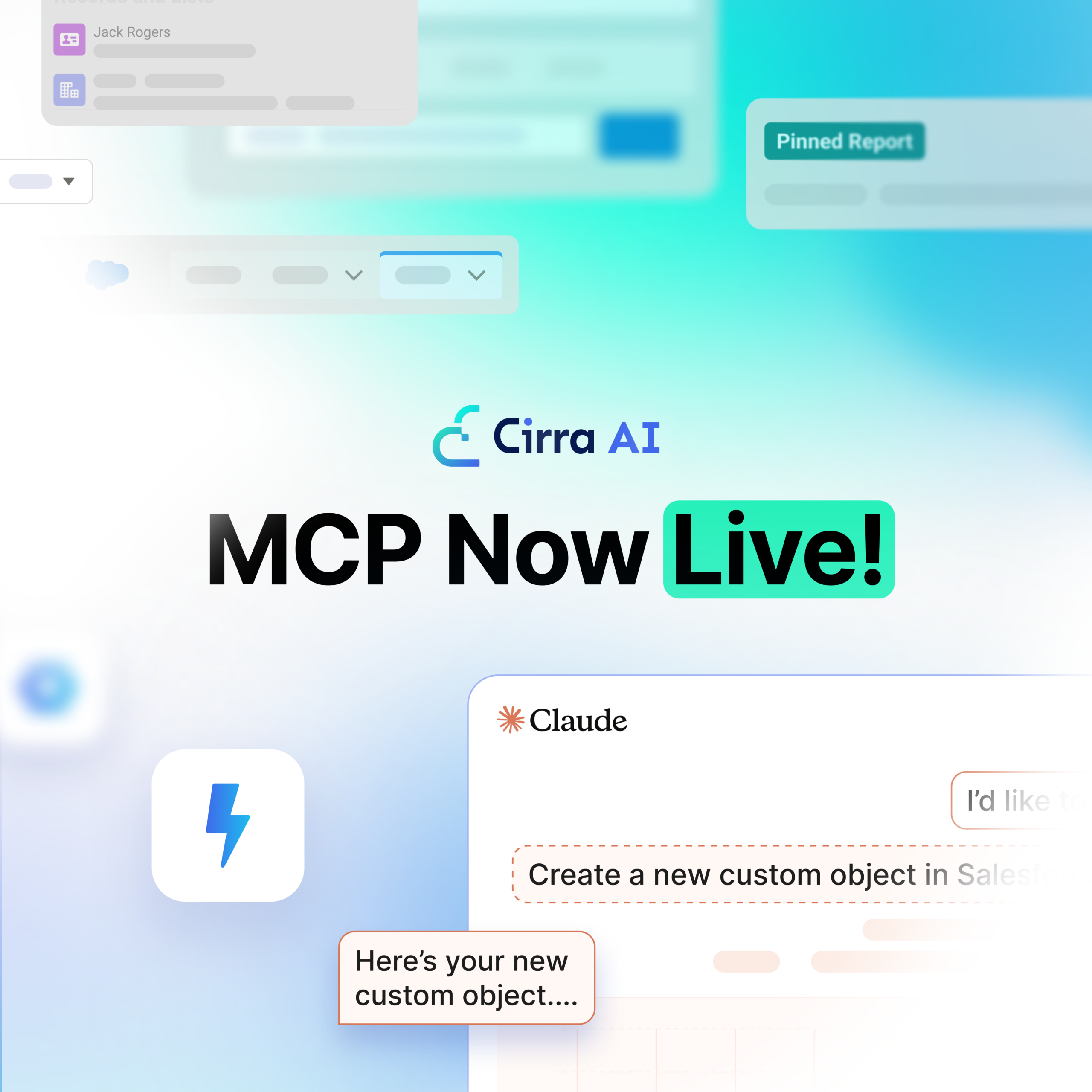
Today, we’re proud to announce the launch of the industry’s first commercial Model Context Protocol (MCP) server designed specifically for Salesforce administration. This breakthrough enables the world’s 200,000+ Salesforce administrators to harness the full power of AI tools like Claude and ChatGPT (soon) for comprehensive org management, fundamentally changing how administrative work gets planned and executed.
What is MCP and Why It Matters
The Model Context Protocol is revolutionizing how AI tools interact with external systems. Think of MCP as a universal translator that allows any AI assistant to securely connect to and control complex software platforms. Instead of AI tools being isolated chat interfaces, MCP enables them to become powerful automation engines that can read, analyze, and modify real systems in real-time.
With the Cirra AI Salesforce Admin MCP, you can manage your Salesforce org directly from your favorite AI assistant. Write your request in plain English (or even use voice input) and refine it in a natural conversation with the AI, while the MCP Server provides access to the org metadata and suggests best practices. Then watch the AI execute complex multi-step updates with detailed explanations and automatic documentation. Goodbye time-consuming and tedious manual clicks in the setup UI; hello natural interaction with a powerful and knowledgeable assistant.
“For too long, Salesforce administrators have been trapped in a cycle of repetitive manual tasks and complex interface navigation,” said Jelle van Geuns, Founder and CEO. “Our MCP server doesn’t just make these processes faster. It makes them fundamentally more intuitive and human. We’re not just solving today’s admin challenges. We’re reimagining what it means to manage enterprise software.”
A New Paradigm
This represents a paradigm shift in enterprise software administration, and we’re just at the beginning. Rather than learning complex user interfaces and memorizing setup procedures, admins can focus on describing the business objectives and the end user experience in plain English. Detailed tasks such as creating custom objects and fields, managing user access across profiles and permission sets, creating flows or analyzing org structure are delegated to an MCP Server that handles the myriad implementation details for each of the metadata types, orchestrated by a powerful AI.
What’s more, the AI becomes a true thought partner to the admin. It helps to think through complex changes, analyzes existing metadata to maximize reuse and remove duplication, and assists with debugging and simplifying validation rules and flows. The AI also provides guidance on best practices and offers insights into how proposed changes fit within existing org architecture.
Van Geuns emphasized the broader transformation: “When administrators can focus on strategy instead of syntax, on outcomes instead of implementation details, the entire organization benefits. We’re moving from an era where administrators need to be walking encyclopedias of setup procedures to one where they can focus on strategic thinking and organizational impact.”
The Power of Connected MCP Servers
But the true transformation happens when multiple MCP servers work together. Imagine an administrator who needs to implement a new sales process. With our Salesforce MCP connected alongside a Jira MCP server, they can:
- Access a Jira ticket and have the AI analyze the requested features
- Answer a few questions to clarify the requirements and approve the proposed implementation
- Watch as the AI creates the necessary Salesforce metadata using the MCP Server
- See the Jira ticket get updated with the new status and implementation details
This connected ecosystem approach means admins can orchestrate changes across multiple systems in a single conversation, eliminating the need to context-switch between different tools and interfaces.
Comprehensive Admin Capabilities
The Salesforce Admin MCP lets administrators create and manage users, profiles, and permission sets, build custom objects with fields, relationships, and page layouts, manage global and standard value sets, configure record types and business processes, create validation rules, flows and APEX, and execute SOQL and metadata queries. All with AI assistance for best practices and optimization, plus the ability to generate comprehensive documentation automatically.
Beyond execution, the MCP server serves as an intelligent planning partner. When faced with complex change requests, administrators can engage in natural conversation to explore implementation options, understand the implications of different approaches, and develop comprehensive plans before making any changes. This collaborative intelligence approach transforms administrators from technical operators into strategic business partners.
“We’re witnessing the dawn of conversational infrastructure management,” van Geuns noted. “This is the future of Salesforce administration, and it’s available today. When AI handles the complexity of implementation details while providing intelligent guidance, administrators become true business strategists.”
Security is Core
Security and compliance form the foundation of our MCP implementation. We follow all best practices established by Anthropic for MCP development, ensuring secure and reliable AI integrations across all supported platforms. Every connection utilizes OAuth authentication, from AI tool integration to Salesforce credential management, with zero storage of passwords and secure management of revokable authentication tokens in accordance with industry best practices. Our MCP server works within the confines of your Salesforce user permissions, ensuring administrators can only perform actions they’re already authorized to execute within their organizations.
“Security isn’t an afterthought in our design. It’s the cornerstone,” van Geuns explained. “Every administrator using our MCP server operates within the exact same permission boundaries they have in Salesforce. We simply make those capabilities accessible through AI, not expand them beyond organizational security policies.”
The Future is Conversational
The launch addresses the evolution of how enterprises think about software administration. As organizations increasingly recognize the strategic value of well-configured systems, administrator roles are shifting toward planning and optimization rather than routine task execution. Our MCP server accelerates this transition by handling implementation details while providing AI-powered insights that help administrators make better decisions.
Organizations can experience this transformation immediately through our free trial plan, which includes full MCP server access with no setup fees or long-term commitments. The platform supports integration with Claude and other MCP-compatible AI tools, providing administrators with flexibility in choosing their preferred AI interface while maintaining consistent access to our Salesforce expertise.
As AI becomes standard infrastructure for enterprise operations, our MCP server gives Salesforce administrators immediate access to this transformation. The future of Salesforce administration is conversational, intelligent, and available now.
Get Started Today
To learn more about our Salesforce Admin MCP or to begin your free trial, visit cirra.ai.
Cirra AI develops AI-powered tools that transform how organizations configure and manage enterprise software. Founded by industry veterans with decades of experience in Salesforce and enterprise software development, we’re pioneering the integration of artificial intelligence into infrastructure management workflows.