Somewhere in your revenue org, someone is fixing a broken validation rule instead of building the next quarter’s territory plan.
They didn’t apply for this job. Nobody hired them to be a Salesforce admin. But the org needed someone to own it, and they were closest to the system. So it became theirs.
This is the accidental admin. The cost of that arrangement rarely shows up on a budget line — it’s a Salesforce admin cost that hides in what doesn’t get done — the pipeline review that slips a week because the dashboard needed rebuilding first, the new hire ramp that stalls because a territory assignment sat in a queue, the strategic project that keeps getting pushed to “next sprint” because there is always a ticket ahead of it.
None of this gets tracked as a cost. Leadership sees a functioning Salesforce org and assumes the system is running fine. Nobody is measuring what that functioning org is quietly costing somewhere else.
The Job Nobody Budgeted For
Most accidental admins are RevOps managers, sales ops leads, or sometimes a VP Sales who got tired of waiting on IT. Their real job is strategy: territory design, forecasting, pipeline analysis, tooling decisions that move revenue.
Instead, a meaningful slice of their week goes to tickets. New field requests. Broken flows. Permission set changes. Report tweaks nobody else can build. None of it is hard, exactly. It just never stops — the kind of work RevOps doing Salesforce admin work knows all too well, and exactly the repetitive, permission-aware work an AI Salesforce admin is built to take on.
Ask most leaders how much time this eats and they will guess low. Ask the accidental admin and the number is usually higher than anyone expected.
The Retention Risk Underneath It
Before the math, it’s worth naming the quieter cost. Most accidental admins did not sign up for this work, and most of them did not get better at it because they wanted to. They got better at it because someone had to.
Over time, a strategic hire who spends a meaningful chunk of their week on ticket triage starts to feel like their role has drifted from what they were hired to do. That mismatch between job title and actual daily work is a real driver of disengagement, and eventually, attrition. Losing a RevOps manager because their strategic work kept getting crowded out by Salesforce upkeep is an expensive way to solve a problem that was never really about headcount.
It’s the kind of cost that doesn’t show up until it’s already happened. The math below is easier to see coming.
A Simple Way to Put a Number on It
You do not need precise data to see the shape of this problem. A rough estimate is usually enough to make the case.
Start with three numbers:
Hours per week spent on Salesforce admin work. Ask the person directly. Most accidental admins can estimate this within a few hours.
Their fully loaded hourly cost. Take their annual compensation, add roughly 30% for benefits, taxes, and overhead, then divide by about 2,000 working hours.
What that time is worth in their actual role. This is the number that matters most, and the one leadership tends to skip, because it is harder to pin down than a salary line. It shows up as a slipped forecast, a territory redesign pushed a quarter, a ramp plan built in a rush instead of with care. It is real cost. It just does not arrive with an invoice attached.
Multiply hours by hourly cost and you get a weekly price tag for the salary side alone. Multiply that by 50 working weeks and the number gets hard to ignore, even before you add what the business loses in delayed decisions and rushed configuration.
A Realistic Scenario
Picture a RevOps manager at a 150-person SaaS company, earning $110,000 a year. Their job description says forecasting accuracy, pipeline hygiene, and sales tooling strategy. In practice, they spend close to a full day a week — call it 7 hours — on Salesforce upkeep: new user setup, field changes requested by sales leadership, a flow that broke after a package update, a dashboard rebuilt the night before a board meeting.
Run the formula. Fully loaded — salary plus benefits, taxes, and overhead, usually about 1.3 times base — that $110,000 is closer to $140,000 a year, or roughly $70 an hour. Seven hours a week at $70 is about $490, or nearly $25,000 a year — just for the hours spent inside Setup instead of on the job they were hired for.
And $25,000 is the floor, not the ceiling. Seven hours a week adds up to about ten working weeks a year — ten weeks that didn’t go to a forecasting model, a territory redesign, or a tooling audit. You don’t need a multiplier to feel the weight of that; you just need to price one thing that slipped. If a delayed territory redesign pushed new-rep ramp back three weeks, what did those three weeks cost in closed pipeline? That one line item often rivals the entire salary figure on its own — which is why the opportunity cost, not the $25,000, is the number worth taking to leadership. It simply never shows up in a spreadsheet.
Multiply this across a sales ops team of two or three, each absorbing a smaller but still real share of admin work, and the hidden Salesforce admin cost compounds quietly in the background of every planning cycle.
The Compounding Effect
The accidental admin problem rarely stays flat. It tends to grow.
As the business adds reps, territories, products, or integrations, the Salesforce org gets more complex. More complexity means more requests. More requests mean less time for anything else. What started as a few hours a week can quietly become half a role, without anyone deciding that should happen.
There is also a quality cost. Configuration work done in stolen pockets of time, between real priorities, tends to be rushed. Fields get added without documentation. Flows get built as one-off fixes rather than scalable solutions. Over time, this creates technical debt inside the org that someone eventually has to untangle, usually at a worse moment than now.
The Real Trade-off
The accidental admin setup looks efficient on paper. No new headcount. No consulting invoice. The work gets done by someone who already understands the business.
But efficiency on paper is not the same as efficiency in practice. Every hour spent inside Setup is an hour not spent on the work that person was actually hired to do. The cost has not disappeared. It has just moved somewhere leadership is not looking: into delayed projects, rushed configuration, and a strategic hire slowly turning into a part-time help desk.
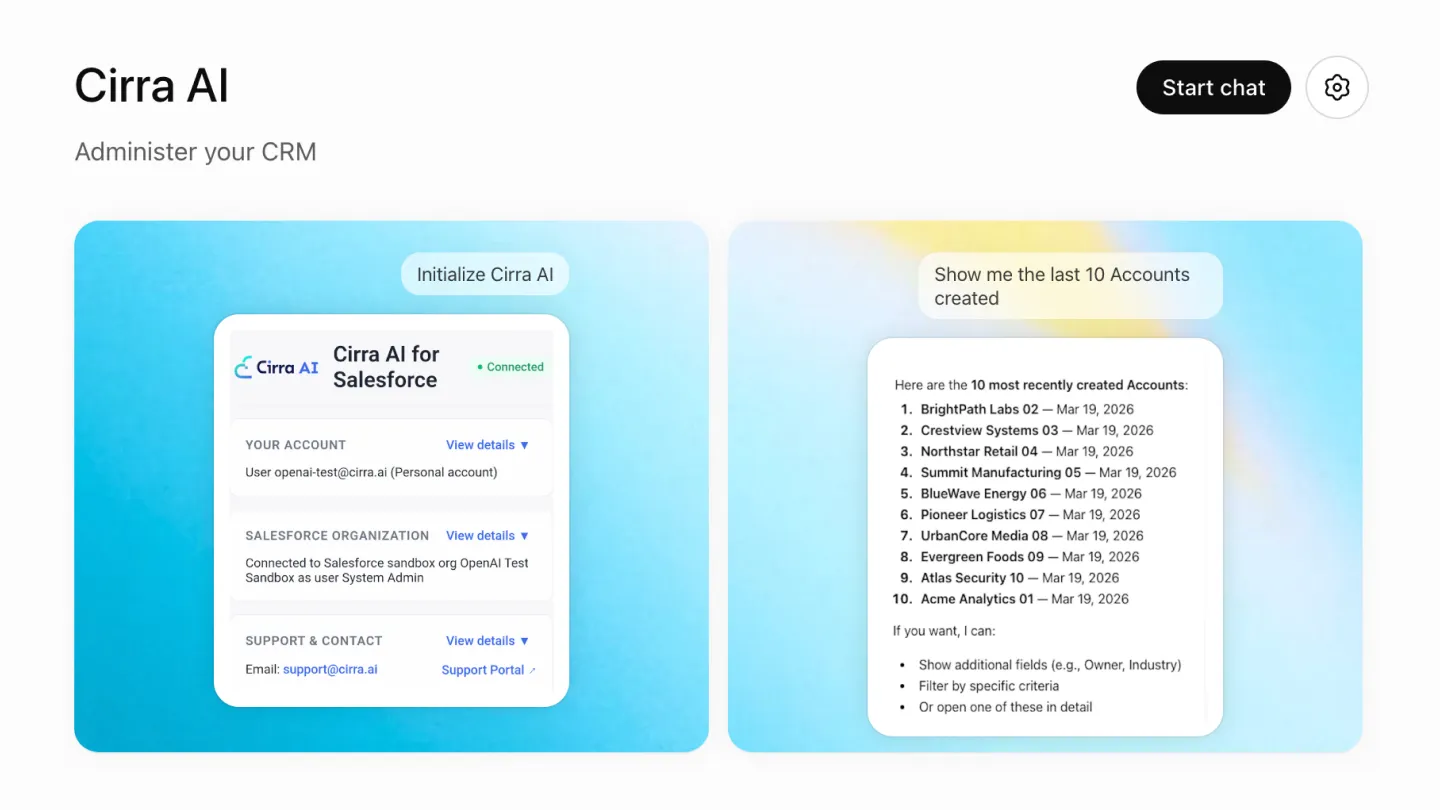
Most teams facing this have historically seen only two ways out: hire a dedicated admin, or bring in a consulting firm on retainer. Both come with a visible cost and a longer commitment, which is exactly why the accidental-admin arrangement persists — it feels free by comparison, even though it isn’t. But those aren’t the only two options anymore. A third category has emerged recently: AI-driven Salesforce administration. An AI Salesforce admin handles the routine configuration work directly, without adding a salary or a retainer to the budget.
Naming the Cost Is the First Step
You cannot fix a cost you have not named. Most RevOps and sales leaders have never actually run the math on what the accidental admin setup costs them in lost focus.
Before your next planning cycle, run the three-number formula above on one person on your team. Their hours, their loaded cost, one honest guess at what a slipped project actually cost the business last quarter. Even a rough number will change the conversation — from “should we get help with Salesforce” to “what is it worth to get this time back.”
And once you’ve priced it, you have something to weigh against the alternatives — including a newer one: an AI Salesforce admin that takes the repetitive Setup work off their plate directly, within your org’s existing permissions, so nothing ships that the person wouldn’t have approved anyway. That’s what turns “what is it worth to get this time back” from a rhetorical question into a number you can actually act on.